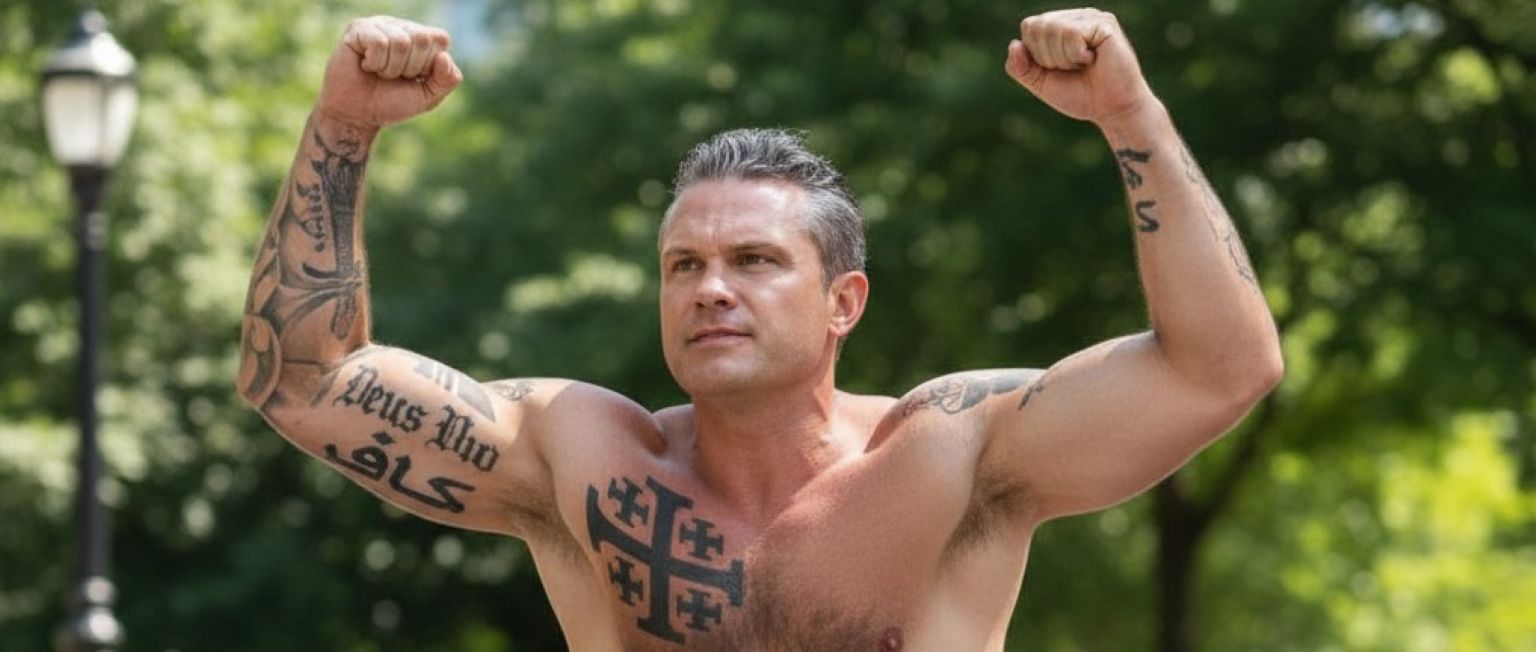
Pete Hegseth, serving as U.S. Secretary of War under President Donald Trump, drew attention for his qualifications, public statements, and personal conduct. Beyond standard scrutiny of military and civilian leadership, Hegseth’s use of Crusader symbolism, public references to religious heritage, and comments about Islam have been highlighted in media coverage.
These aspects of his public persona have prompted domestic and international discussion. Media reports note tattoos, speeches, and commentary referencing historical Christian-Muslim conflict, Israel’s history, and U.S. religious heritage, raising questions about the intersection of personal beliefs and public leadership.
Critics question whether the U.S. Secretary of War emphasizing personal symbolism can consistently uphold meritocratic principles. Supporters emphasize that civilian oversight of the military does not require prior four-star military experience and argue that ideological perspective does not automatically preclude effective leadership. This article summarizes reporting on Hegseth’s qualifications, public statements, and imagery, examines coverage in Arabic-language media, and discusses potential implications for service members and international perception.
Disclaimer: The following content is based on media reports, commentary, and publicly available statements. No assertion is made regarding criminality or unverified personal conduct. Reported statements and analyses do not constitute official U.S. policy.
Background and Qualifications: The Merit Debate
Hegseth previously served as an officer in the Army National Guard, departing service with the rank of major (Dorn, 2025). The role of U.S. Secretary of War involves oversight of a global defense apparatus, combatant commands, nuclear strategy, procurement systems, and international alliances. Historically, many defense secretaries have had senior-level military or government experience.
Before his appointment, Hegseth was a media host and commentator on Fox News, including Fox & Friends Weekend (Dorn, 2025). Analysts and former defense officials questioned whether his prior experience matches traditional qualifications for the role (The Guardian, 2025). Supporters argue that civilian oversight does not require prior four-star command experience and that an external perspective can provide value.
Some reports note that Hegseth has publicly expressed support for policies emphasizing U.S. Christian heritage and “Judeo-Christian values” (The Guardian, 2025; The Christian Post, 2025). Analysts suggest these positions may shape international perceptions of U.S. military leadership.
Religious Symbolism, Crusader Imagery, and Statements on Islam
Hegseth has been reported to have tattoos including the phrase “Deus Vult”, historically associated with the Crusades, and an Arabic word sometimes translated as “kafir”, meaning “infidel” (Yahoo News, 2025). Media coverage highlights his references to historical Christian-Muslim conflict, which some commentators interpret as ideological messaging, while supporters describe them as personal expression (The Guardian, 2025).
In a 2018 speech in Israel, Hegseth referenced historical dates—1917, 1948, 1967, and 2017—as significant in Israeli history and described them as “miracles.” He also suggested that rebuilding a Jewish temple on Jerusalem’s Temple Mount was not impossible (The Christian Post, 2025; The Times of Israel, 2025). The Temple Mount is the site of the Al-Aqsa Mosque, one of Islam’s holiest sites. Observers note that such statements are sensitive due to the historical and religious significance of the location. Many Muslims worldwide view the U.S.-Israel alliance as a modern form of Crusade, and references to Crusader imagery or historical Christian-Muslim conflict could further damage the perception of the United States in those regions.
Personal Controversies
Media reporting during Hegseth’s confirmation process included:
- A 2017 sexual assault allegation, which Hegseth denied; reports indicate the matter was resolved privately without criminal conviction (Dorn, 2025).
- Public acknowledgment of marital infidelity (KSAT, 2025).
- Reports of alcohol use at professional events, which he has denied as ongoing (The Guardian, 2025).
No criminal convictions were recorded. Analysts noted that judgment and conduct can be considered in evaluating senior leadership appointments.
DEI, “Merit,” and Institutional Reform
Hegseth has opposed certain diversity, equity, and inclusion (DEI) initiatives, arguing for promotion and assignments based on merit (Associated Press, 2025). Some DEI programs were reportedly reduced under his leadership. Supporters argue that these changes strengthen standards, while critics suggest reducing DEI frameworks could affect recruitment, retention, and cohesion (The Washington Post, 2026). Media reports highlight tension between the public emphasis on merit and political appointment processes.
Potential Implications for Diversity and Morale
More than half of U.S. service members identify as racial, ethnic, or religious minorities. Repeated emphasis on White Christian symbolism, Crusader imagery, or religiously framed rhetoric by senior leaders could influence perceptions within the ranks.
While the U.S. military formally prohibits discrimination and emphasizes professional standards and unit cohesion, some service members may feel alienated if messaging appears to favor one faith or cultural identity. Analysts note that such perceptions, even if unintentional, could affect morale, trust, and the sense of inclusion among diverse personnel. The overall impact is likely context-dependent: strong or repeated ideological framing presents a higher risk of perceived divisions, whereas occasional or symbolic references may have limited effect.
Comparative Analysis: Arabic-Language Media Framing
Arabic-language media coverage emphasizes several themes:
- Historical Context – Crusader imagery is often interpreted through the lens of medieval European campaigns in the Middle East. Modern conflicts, including U.S. involvement in Afghanistan, Iraq, Libya, Syria, Yemen and now Iran, are sometimes framed as benefiting Israel strategically. These interpretations are occasionally connected to narratives about a “Greater Israel.” Symbolic references to Crusader history by Western figures can amplify these narratives.
- Temple Mount Sensitivity – Hegseth’s comments about rebuilding a Jewish temple on the Temple Mount are highly sensitive, as the site is sacred to both Jews and Muslims (The Christian Post, 2025). Arabic-language media often interpret such statements as reflecting American Christian Zionist ideology, which can inflame regional tensions, influence anti-U.S. sentiment, and complicate diplomatic efforts (Carmichael, 2020; The Times of Israel, 2025).
- Perceived Ideological Alignment – Hegseth’s tattoos and statements suggest a personal ideology aligned with American Christian Zionist beliefs (Yahoo News, 2025; The Christian Post, 2025; Carmichael, 2020). Arabic-language media and analysts interpret these elements as signaling alignment between U.S. leadership and a religiously influenced vision for Israel. Supporters frame these actions as personal expression, while critics argue repeated emphasis on religious symbolism by senior leaders blurs the line between personal belief and professional responsibility.
- Social Media Amplification – Hegseth’s symbolic tattoos and speeches circulate widely across social media, increasing visibility and shaping perceptions both domestically and internationally (Yahoo News, 2025; The Guardian, 2025; Carmichael, 2020). This amplification transforms personal expression into widely circulated political and symbolic messages, influencing how U.S. officials’ actions are interpreted globally.
Policy, Perception, and Media Amplification
No official evidence suggests that U.S. military operations are guided by religious doctrine; strategic, legal, and geopolitical frameworks govern decisions. Nevertheless, public statements and symbolic imagery can influence perceptions abroad, especially in regions with historical sensitivities.
Recent media reports highlight concerning rhetoric from some military leaders. For example, officers have allegedly used Christian prophecies to frame operations, including conflicts with Iran, in spiritual or apocalyptic terms (The Young Turks, 2026; Military.com, 2026). Critics argue such rhetoric could blur the line between religious belief and military duty, potentially undermining professionalism and neutrality.
Personal Reflections
Former service members note that leadership symbolism and ideological references receive wide international attention. Media reactions vary and do not necessarily reflect official U.S. policy, but they illustrate the role of public perception in shaping morale and international understanding.
The U.S. military formally prohibits discrimination based on race or religion. Nonetheless, repeated emphasis on religious symbolism, historical imagery, and changes to DEI initiatives can affect perceptions of fairness and institutional culture. These reflections are descriptive, not assertions of misconduct.
References
- Associated Press. (2025). Hegseth moves to dismantle diversity initiatives at the Pentagon. AP News. https://apnews.com
- Dorn, S. (2025). Pete Hegseth sworn in as defense secretary after Senate vote. Forbes. https://www.forbes.com
- KSAT. (2025). Hegseth’s views on women in combat, infidelity, and more in his own words. KSAT News. https://www.ksat.com
- The Christian Post. (2025). Pete Hegseth floats third Jewish temple in unearthed speech. The Christian Post. https://www.christianpost.com
- The Guardian. (2025). Pete Hegseth faces scrutiny over past conduct in confirmation hearings. The Guardian. https://www.theguardian.com
- The Times of Israel. (2025). Trump’s nominee for Pentagon chief suggested new temple could be built on Temple Mount. The Times of Israel. https://www.timesofisrael.com
- Carmichael, C. (2020). American Christian Zionism and the politics of the Holy Land. Palgrave Macmillan.
- Yahoo News. (2025). Pete Hegseth criticized over Arabic tattoo and symbolism. https://www.yahoo.com
- The Washington Post. (2026). Hegseth pressures institutions over diversity policy shifts. https://www.washingtonpost.com
- The Young Turks. (2026, March 4). U.S. commanders are telling our troops WHAT?!?! [Video]. YouTube. https://www.youtube.com/watch?v=GVOVqG6Mh40
- Military.com. (2026, March 3). Military officers accused of framing Iran war as biblical mandate. Military.com. https://www.military.com/daily-news/2026/03/03/military-officers-accused-of-framing-iran-war-biblical-mandate.html
Leave a Reply