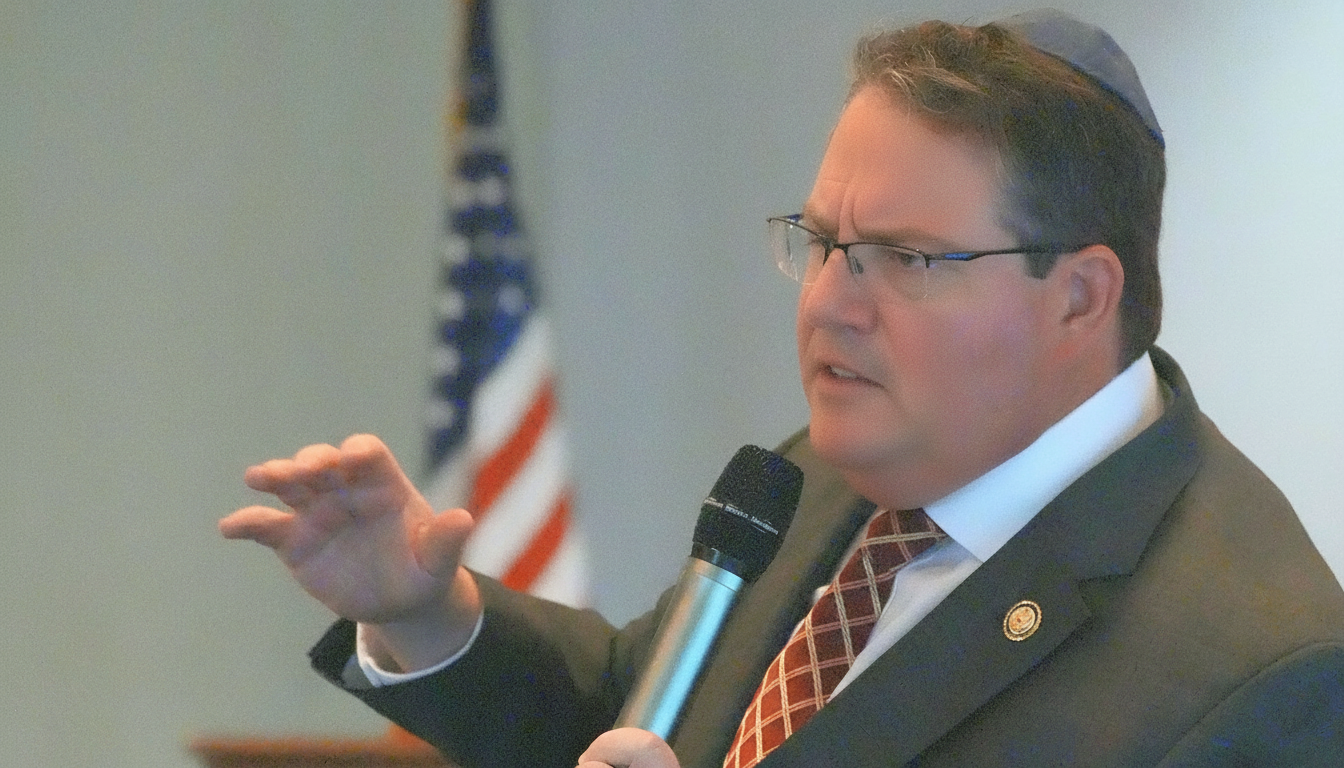
Bigotry on Display: Florida Representative Randy Fine’s Anti-Muslim Rhetoric and the Dangerous Silence of His Party
When an elected official publicly declares that “the choice between dogs and Muslims is not a difficult one,” it is not a slip of the tongue—it is a vicious, intentional act of dehumanization. Florida Representative Randy Fine’s statement about Muslim Americans is not just offensive; it constitutes a stark attack on a constitutionally protected religious community.
This is not mere political rhetoric. This constitutes an assault on human dignity. History has shown us the disastrous effects of equating human beings with animals—whether in Nazi Germany or the wartime demonization of Japanese civilians. Such rhetoric paves the way for discrimination, violence, and atrocities. When a lawmaker resorts to it, the consequences are amplified, normalized, and emboldened, putting entire communities at risk.
This article exposes the toxic context of Fine’s words, the troubling silence of his party, the historical precedents of dehumanization, and potential political fallout for anyone who chooses to alienate Muslim American voters.
Dehumanizing Rhetoric
Fine’s comment wasn’t a minor gaffe. It was a deliberate attack—a direct comparison of a faith community to animals. This language has been weaponized for centuries to strip people of their humanity, and civil rights organizations have long warned us about its implications (ADL, 2023; CAIR, 2024).
This isn’t simply about partisan squabbles; it represents a moral failing at its most raw and dangerous. Following the Hamas attacks of October 7, 2023, Fine did not merely express support for Israel; he escalated his rhetoric, posting inflammatory statements that that many interpreted as labeling all Palestinians as complicit in violence. This blanket condemnation serves to demonize an entire demographic based on the actions of a few, further fueling anti-Muslim sentiment.
Additionally, Fine has made statements implying that Islamic practices threaten American values, thereby reinforcing harmful stereotypes and framing Muslims as outsiders. Such rhetoric significantly contributes to societal division and mistrust.
The Council on American-Islamic Relations (CAIR) has strongly warned that such inflammatory language doesn’t exist in isolation—it directly contributes to a rise in harassment and hate crimes (CAIR, 2024). The Anti-Defamation League (ADL) has documented how dehumanizing language, particularly when likening people to animals, precedes violence and discrimination (ADL, 2023). Fine’s comments are not only incendiary—they reflect a deeply troubling historical pattern that we cannot afford to ignore.
This isn’t just politics—it’s moral vandalism.
Silence and Political Cowardice
Equally disturbing is the silence from Fine’s own party. The Republican Party tolerates racism and Islamophobia within its ranks, a stance that reflects not true conservatism but a troubling form of right-wing extremism. This silence is not neutral—it is complicity. It sends a dangerous message: anti-Muslim bigotry is not only tolerated; it is politically expedient.
While House Democrats and civil rights organizations have called for accountability, no significant action has been taken. Fine has also made dismissive remarks when confronted by constituents about his views on Muslims, further illustrating his unwillingness to engage in constructive dialogue. The lack of action against elected officials who weaponize hatred is a betrayal of the principles democracy stands for. This clear inaction indicates that bigotry is politically survivable.
This approach risks alienating a vital community in the long run. The notion that exploiting bigotry can yield electoral gains may backfire, as the very voters these officials seek to marginalize could rise to hold them accountable.
Muslim American Voters and the Political Stakes
Muslim Americans are no longer a marginal voting bloc—they are a formidable force in key swing states. Politicians who continue to vilify this community will face consequences at the ballot box.
In the 2024 presidential elections, it became evident that President Biden’s continued support for Israel’s military campaign in Gaza—amid mounting civilian casualties, the deaths of over 70,000 Palestinians, the vast majority of whom were women and children, and the ruling by the International Court of Justice that Palestinians’ rights to protection from genocide were “plausible” in the case South Africa v. Israel (Genocide Convention case)—significantly influenced the political environment shaping Kamala Harris’s electoral strategy. Muslim American advocacy groups expressed outrage over U.S. policy regarding Gaza, and this reaction represented not just moral outrage—it was a political time bomb (International Court of Justice, 2024; Human Rights Watch, 2024; BBC News, 2024; ICC, 2024; OCHA, 2024).
This did not necessarily mean that large numbers of Arab and Muslim voters shifted their allegiance to Trump and the Republican Party; rather, a significant number chose to either abstain from voting or cast ballots for third-party candidates including my own family. This shift ultimately paved the way for Trump’s success, sending a strong message that support for actions perceived as genocidal comes with severe political repercussions (Smith, 2024).
This isn’t merely about policy disagreements—it’s about human lives and justice. Lawmakers who continue to tolerate bigotry against Muslim Americans will soon find that their electoral support is neither automatic nor guaranteed. It is earned or forfeited at the ballot box. The choice is stark: stand with humanity or lose the loyalty of a critical, politically engaged demographic.
Dehumanization and Historical Lessons
History has shown us the terrible consequences of dehumanization. In Nazi Germany, propaganda depicted Jewish people as vermin, animals, and parasites, paving the way for one of the most horrific genocides in human history (USHMM, n.d.). Similarly, in the United States during World War II, propaganda portrayed Japanese civilians as animals, enabling mass internment and civil rights violations.
Civil rights groups and historians have long warned us that dehumanizing language is never harmless; it strips away the moral and social guardrails meant to prevent intolerance, violence, and discrimination (ADL, 2023). Fine’s comments regarding Muslims echo that same toxic legacy—and we must reject it before it leads to even worse consequences.
Identity, Responsibility, and Moral Blindness
It is particularly troubling that Randy Fine is publicly known to be Jewish. This should make him more sensitive to the dangers posed by dehumanizing language. History is replete with examples of how antisemitic propaganda has led to some of the worst atrocities humankind has ever witnessed. The lessons inherent in this history should make every elected official hyper-aware of the devastating impact of such rhetoric (USHMM, n.d.).
The historical suffering of one group does not grant permission to perpetuate bigotry against another. Fine’s comments violate this fundamental principle.
Constitutional and Democratic Accountability
The First and Fourteenth Amendments guarantee free speech and religious liberty (U.S. Const. amend. I; amend. XIV). However, these rights do not shield elected officials from the moral and political repercussions of their words. Voters, legislative bodies, and civil society must hold public officials accountable for rhetoric that undermines entire communities.
Censure, removal from committees, and electoral consequences are not optional—they are essential to uphold democratic norms and deter bigotry.
Conclusion: Words Have Consequences
Randy Fine’s anti-Muslim rhetoric is not merely offensive; it is corrosive, morally reckless, and politically dangerous. The silence of political leaders, particularly from his own party, stands as a tacit endorsement of such harmful language.
History has shown us that words matter. Nazi propaganda, wartime dehumanization, and systemic prejudice all began with language. Muslim Americans, like all citizens, deserve dignity, respect, and protection from officials who attempt to strip them of their humanity. Lawmakers who fail to uphold this principle will face not only ethical scrutiny but electoral consequences.
In a democracy, words are not free from consequences. The choice is clear: either uphold equality and respect for all or normalize bigotry and pay the price at the ballot box.
References
– Anti-Defamation League. (2023). Dehumanization: Historical roots and contemporary consequences. https://www.adl.org
– Council on American-Islamic Relations. (2024). Condemnation of anti-Muslim rhetoric by public officials. https://www.cair.com
– International Court of Justice. (2024, January 26). Application of the Convention on the Prevention and Punishment of the Crime of Genocide in the Gaza Strip (South Africa v. Israel): Order on provisional measures. https://www.icj-cij.org/case/192
– Human Rights Watch. (2024). Israel/Palestine: Events of 2023. https://www.hrw.org/world-report/2024/country-chapters/israel-and-palestine
– BBC News. (2024, January 26). ICJ orders Israel to prevent genocidal acts in Gaza but stops short of ceasefire. https://www.bbc.com/news/world-middle-east-68104907
– Smith, J. (2024). Election analysis: Impact of U.S. policy on Muslim American voters. Journal of Political Science, 47(3), 123-145.
– Fine, R. (2023–2024). Public posts regarding Israel–Hamas war and comments on Muslims [Social media posts]. X (formerly Twitter).
– International Criminal Court. (2024). Situation in the State of Palestine. https://www.icc-cpi.int
– United Nations Office for the Coordination of Humanitarian Affairs (OCHA). (2024). Humanitarian situation update – Gaza Strip. https://www.ochaopt.org
– United States Holocaust Memorial Museum. (n.d.). Dehumanization. https://www.ushmm.org
– U.S. Constitution amend. I; amend. XIV
Leave a Reply